

Physical healthcare relies on First Aid to stabilize injuries before professional treatment is available; mental healthcare has no established equivalent. As set out in the Second Aid Whitepaper, Second Aid fills that gap with immediate, self-administered support, reducing the escalation of emotional distress and the resulting pressure on mental-health services.
The Missing First Aid Layer
Modern physical healthcare does not depend entirely on hospitals, doctors and emergency services. When someone experiences a minor physical injury, First Aid provides an immediate response. A wound can be cleaned, bleeding can be controlled and the injured person can be stabilized before professional treatment is considered or obtained.
Without First Aid, a much greater proportion of physical injuries would depend on professional medical intervention, increasing pressure on healthcare services and allowing some preventable complications to develop.
Without First Aid, physical healthcare systems would be overwhelmed, resulting in avoidable fatalities. This is the current state of mental healthcare without Second Aid.
The Three Critical Gaps
Mental healthcare has no equally established, universally accessible system for immediate self-stabilization. This leaves three critical gaps that First Aid already closes in physical health, and Second Aid now closes in mental health:
-
Disclosure Gap
Many people are unwilling or unable to ask for help. 41% of US adults are not comfortable asking for help.1
Private, self-use support that does not depend on disclosure or asking for help.
-
Access Gap
Acute incidents require in-the-moment stabilization. 11.2% of individuals experience panic attacks.2
Always-visible stabilization tools, immediately usable without any access barriers.
-
Time Gap
Incidents requiring professional support may not receive it in time.
Immediate stabilization support until professional assistance is available.
Mental healthcare needs the same layer that physical healthcare already has: a simple, accessible, early self-stabilization tool. Second Aid provides it.
And with a feasible solution now existing for these gaps, employers have a legal obligation to address them.
Why Availability Is Not Enough
Making support available is not enough. Immediate support only helps if people can reach it, are willing to use it and actually turn to it when distress strikes, and much existing support fails on at least one of these.
That is why Second Aid's design is founded on three scientific domains: epidemiology, social science and behavioral psychology, each removing a different barrier between support existing and support being used.
- Epidemiology
-
Support that depends on trained people can only reach as far as the number of people trained, and training cannot keep pace with an entire population. Population-wide coverage requires support people can use themselves.
Second Aid is designed to be used alone, with no training: a single kit can serve everyone who passes it.
- Social Science
-
Many people in distress never seek help, often because doing so means admitting to someone else that they are struggling. Support needs to work without requirement of disclosure.
Second Aid is used privately and anonymously, with no need to give an identity or tell anyone.
- Behavioral Psychology
-
Even when support exists, people may not remember it, or reach for it, when distress hits. Support needs a visible cue at the point of need.
Placing Second Aid alongside First Aid kits puts that cue where people already go when something goes wrong.
Together, these allow Second Aid to close the gaps above not only in principle, but in practice: reaching everyone, without stigma, at the moment support is needed.
System-Level Impact
The central proposition behind Second Aid, set out in the whitepaper Mental First Aid as Missing Public-Health Infrastructure, is that mental healthcare could benefit from the same distributed first-response infrastructure that exists in physical healthcare. Without First Aid, more physical injuries would rely directly on hospitals and medical professionals, increasing healthcare demand and preventable complications. Second Aid proposes introducing an equivalent layer into mental healthcare.
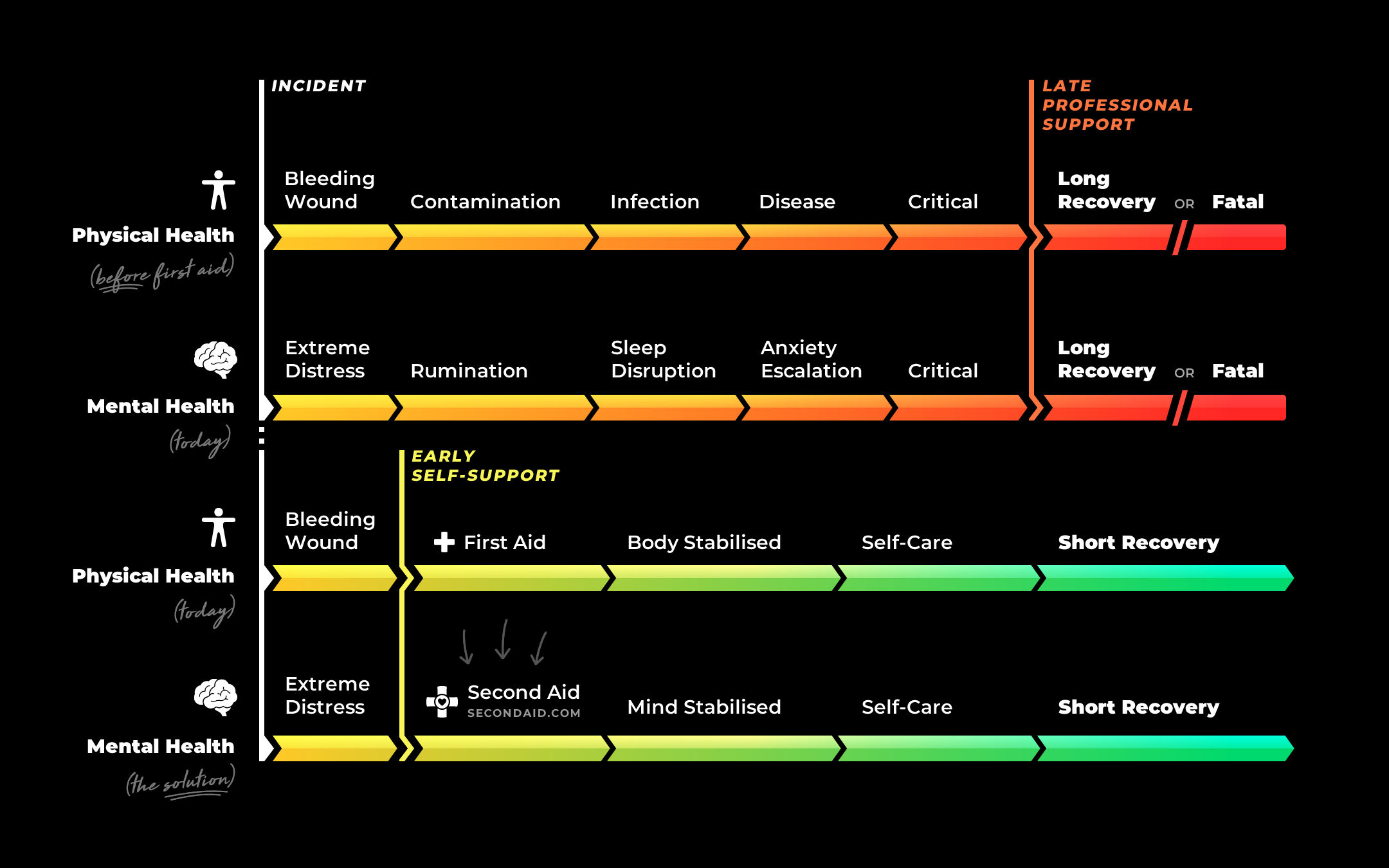
By making immediate self-stabilization widely available, the intended effects include:
- More emotional distress addressed at an earlier stage.
- Reduced escalation of some episodes of acute distress.
- Less dependence on the immediate availability of another person.
- Reduced pressure on mental-health services.
- More appropriate use of professional mental-health services.
- Greater accessibility of support in everyday environments.
- Earlier contact with further assistance when required.
At population scale, these changes could contribute to preventing serious downstream outcomes, including some suicide attempts and deaths.
This is the proposed public-health impact of Second Aid, not an outcome already established by clinical or population-level research. The two-year Help Me Calm Down™ evaluation provides evidence relevant to the feasibility of independent self-stabilization, but does not establish reductions in suicide, emergency-service demand or overall healthcare utilization. Further research is required to measure these broader effects.
Normalizing Mental-Health
The ultimate goal of Second Aid is to reframe mental health as normal, actionable and shared. Why? Because it quietly dismantles shame, the single biggest accelerant of mental illness.
Health norms have historically changed through tools rather than education. Soap normalized hygiene. Seatbelts normalized road safety. First Aid normalized physical health. Second Aid normalizes mental health.
With Second Aid kits placed beside First Aid kits, that change becomes visible in workplaces, schools and public spaces: looking after your mental health is as normal as looking after your physical health.
This cannot be achieved alone. Organizations and individuals who share this mission can join the Partner Program and help place Second Aid beside every First Aid kit across the globe.