

Physical healthcare relies on First Aid to stabilise injuries before professional treatment is available; mental healthcare has no established equivalent. As set out in the Second Aid Whitepaper, Second Aid fills that gap with immediate, self-administered support, reducing the escalation of emotional distress and the resulting pressure on mental-health services.
The Missing First Aid Layer
Modern physical healthcare does not depend entirely on hospitals, doctors and emergency services. When someone experiences a minor physical injury, First Aid provides an immediate response. A wound can be cleaned, bleeding can be controlled and the injured person can be stabilised before professional treatment is considered or obtained.
Without First Aid, a much greater proportion of physical injuries would depend on professional medical intervention, increasing pressure on healthcare services and allowing some preventable complications to develop.
Without First Aid, physical healthcare systems would be overwhelmed, resulting in avoidable fatalities. This is the current state of mental healthcare without Second Aid.
The Three Critical Gaps
Mental healthcare has no equally established, universally accessible system for immediate self-stabilisation. This leaves three critical gaps that First Aid already closes in physical health, and Second Aid now closes in mental health:
-
Disclosure Gap
Many people are unwilling or unable to ask for help. 41% of US adults are not comfortable asking for help.1
Private, self-use support that does not depend on disclosure or asking for help.
-
Access Gap
Acute incidents require in-the-moment stabilisation. 11.2% of individuals experience panic attacks.2
Always-visible stabilisation tools, immediately usable without any access barriers.
-
Time Gap
Incidents requiring professional support may not receive it in time.
Immediate stabilisation support until professional assistance is available.
Mental healthcare needs the same layer that physical healthcare already has: a simple, accessible, early self-stabilisation tool. Second Aid provides it.
Consequences of Delayed Intervention
Professional mental-health services are essential, but they are not designed to provide immediate assistance for every episode of emotional distress. Access may depend on location, available personnel, appointment schedules, cost, communication and an individual's willingness or ability to request assistance. In some circumstances, waiting for assistance may allow emotional distress to worsen.
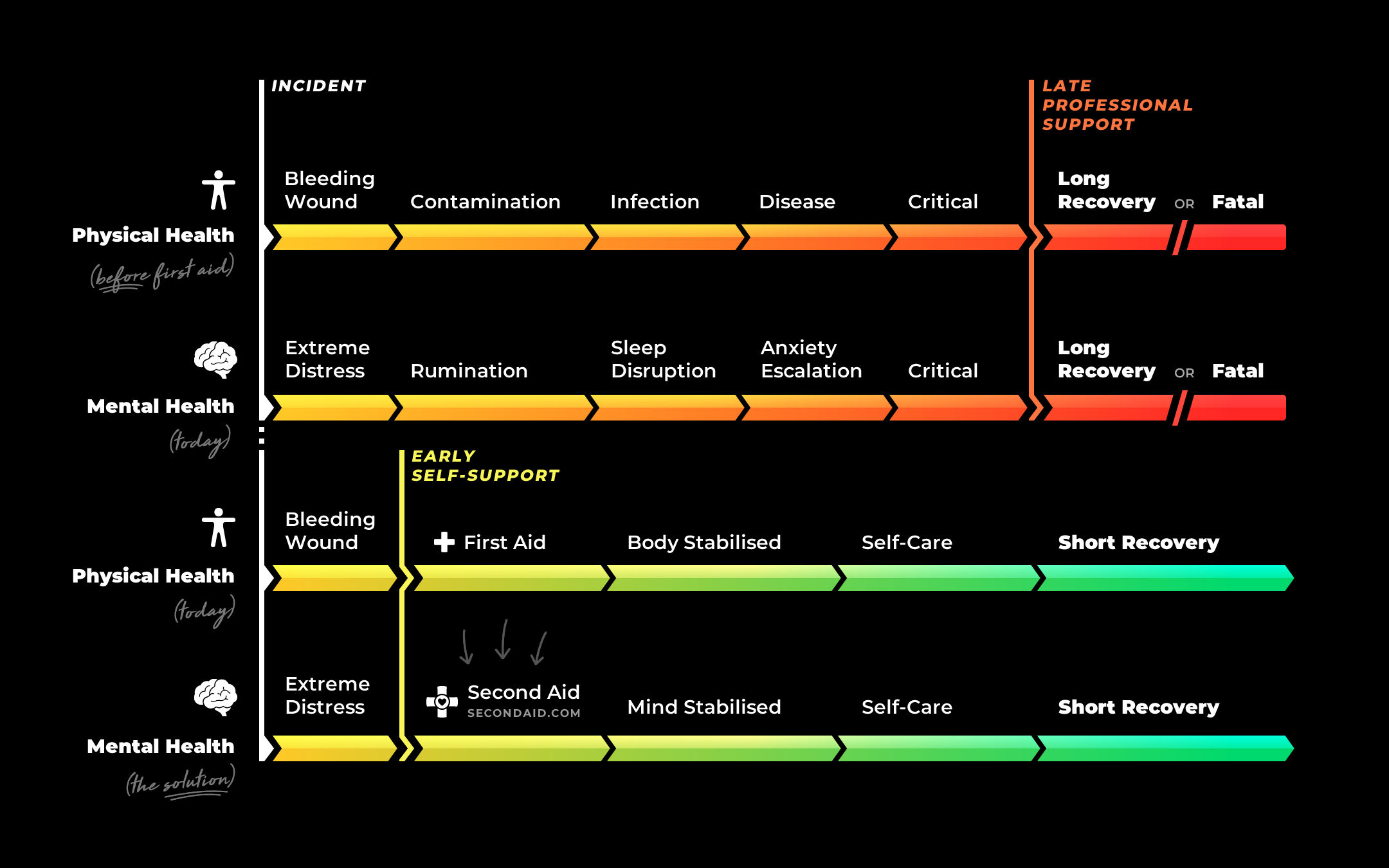
Second Aid addresses the period before professional intervention by giving individuals immediate access to structured self-stabilisation exercises. Its purpose is to make early support available without making that support dependent on professional availability.
System-Level Impact
The central proposition behind Second Aid, set out in the whitepaper Mental First Aid as Missing Public-Health Infrastructure, is that mental healthcare could benefit from the same distributed first-response infrastructure that exists in physical healthcare. Without First Aid, more physical injuries would rely directly on hospitals and medical professionals, increasing healthcare demand and preventable complications. Second Aid proposes introducing an equivalent layer into mental healthcare.
By making immediate self-stabilisation widely available, the intended effects include:
- More emotional distress addressed at an earlier stage.
- Reduced escalation of some episodes of acute distress.
- Less dependence on the immediate availability of another person.
- Reduced pressure on mental-health services.
- More appropriate use of professional mental-health services.
- Greater accessibility of support in everyday environments.
- Earlier contact with further assistance when required.
At population scale, these changes could contribute to preventing serious downstream outcomes, including some suicide attempts and deaths.
This is the proposed public-health impact of Second Aid, not an outcome already established by clinical or population-level research. The two-year Help Me Calm Down™ evaluation provides evidence relevant to the feasibility of independent self-stabilisation, but does not establish reductions in suicide, emergency-service demand or overall healthcare utilisation. Further research is required to measure these broader effects.
Normalising Mental-Health
Physical First Aid kits are a familiar part of schools, workplaces and public environments. Their presence makes responding to physical injury a normal and expected activity.
Second Aid proposes extending that principle to mental health.
Health norms have historically changed through tools rather than education. Soap normalised hygiene. Seatbelts normalised road safety. First Aid normalised physical health. Second Aid normalises mental health.
The intended long-term effect is to normalise practical mental-health support as part of ordinary public-health provision.