

Second Aid combines physical accessibility with interactive, self-use psychological support and built-in emergency access. The system is designed to be simple enough for somebody experiencing emotional distress, including in an emergency, to use without preparation, professional assistance or prior training.
The Second Aid Kit
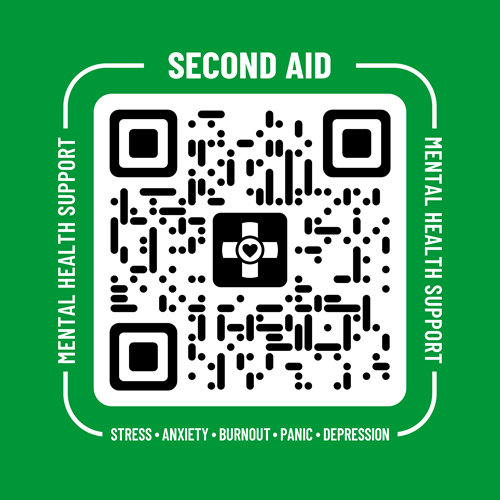
A Second Aid kit is a QR code that provides access to Second Aid's interactive mental-health support system. Unlike a physical First Aid kit containing bandages and medical supplies, a Second Aid kit provides digital access to guided psychological exercises and support pathways.
Because a Second Aid kit is simply a printed QR code, it can be deployed immediately, at minimal cost and in almost any location, with no hardware, software installation or staff training required. This simplicity is central to the design: it allows Second Aid to be placed wherever First Aid already is, and further.
The preferred deployment model places the Second Aid QR code alongside an existing First Aid kit. This creates a consistent distinction:
- First Aid for Physical Health.
- Second Aid for Mental Health.
The Second Aid kit can also be placed in other appropriate, visible locations where somebody may need immediate and private access to support, such as bathrooms, kitchens and break areas, places people often retreat to when in distress.
A smartphone with a compatible camera or QR scanner and internet access is ordinarily required to use the QR code. Second Aid can also be accessed directly through secondaid.com.
The User Journey
The standard Second Aid experience follows a simple sequence.
-
Find Second Aid
The person sees a Second Aid QR code or accesses secondaid.com directly.
-
Open Second Aid
Scanning the QR code opens the interactive Second Aid application. There is no requirement to create an account or provide personal information before accessing the support exercises.
-
Select the Appropriate Support
The user chooses an exercise according to what they are experiencing or the support they want. The available pathways address different types of emotional difficulty.
-
Follow the Exercise
The application provides interactive guidance intended to help the person regulate their emotional state, process their experience or identify a constructive next step. The user follows the instructions independently.
-
Consider Further Support
After using Second Aid, the person can consider whether additional support is required. Helplines and one-tap emergency calling are available at any point, without completing an exercise.
Second Aid can be used immediately, with no account, login or registration. Users are never asked for their name, email address or any other personal information, and no personal data is collected. How Second Aid protects user privacy is explained in the Privacy section of the Safety chapter.
Self-Stabilisation
Self-stabilisation is the central function of Second Aid. It refers to an individual's attempt to regain emotional regulation and sufficient psychological composure using a structured intervention that does not require another person to administer it.
This is particularly relevant in situations where someone:
- Does not want to disclose their emotional distress.
- Is unable to explain what they are experiencing.
- Cannot immediately reach a trained supporter.
- Is waiting for professional assistance.
- Needs to stabilise before deciding what to do next.
Traditional support arrangements frequently depend on communication with another person. Second Aid adds a different option by placing a self-use stabilisation support tool directly within the user's environment.
Self-use does not mean that professional assistance is unnecessary. It means that an initial stabilisation attempt can be made without depending on the immediate presence of another person.
The Exercises
Second Aid provides five exercises designed for different emotional circumstances. Each one is interactive and follows three guided steps, using techniques drawn from established psychological therapies rather than applying one identical intervention to every type of distress.
The Core Exercise
"Help Me Calm Down" is Second Aid's core stabilisation exercise and its most important. It is the first option users see in distress, alongside "Talk to someone", with all other exercises shown only after selecting "See more".
Help Me Calm Down
Reduces physical tension, interrupts spiralling thoughts and restores control, using calming audio, soothing visuals and relaxation techniques. Its core sequence originated in the standalone Help Me Calm Down™ tool.
Draws on CBT, ACT and mindfulness-based therapies.
-
Abdominal Breathing
An animated circle guides slow diaphragmatic breathing with a longer exhale, helping to calm the body and counter hyperventilation.
-
Emotion Check-In
Users mark each emotion on a list as "yes", "a little" or "no", naming what they feel and creating distance from it.
-
Embracing Peace
Selected emotions are revisited with the same paced breathing, easing difficult emotions on the exhale and reinforcing positive ones on the inhale.
Supplementary Exercises
The following four exercises were requested by users of the original Help Me Calm Down™ tool, extending Second Aid to other forms of distress. They are shown after selecting "See more".
Grief Exercise
Helps process loss, organise unresolved emotions and maintain a continuing bond while adapting to absence.
Draws on grief therapy and expressive writing.
-
Untangling Emotions
A structured emotion check-in brings clarity to complex grief responses.
-
Light Release
A private, one-way messaging interface, a modern form of letter-writing, for expressing unresolved thoughts without expecting a reply.
-
Invisible Connections
An animation of two lights, one of which fades, widens to reveal many others who have experienced the same loss, reducing the sense of isolation.
Overwhelm Exercise
Identifies imbalance between mind and body, then restores clarity and control.
Draws on behavioural activation, cognitive load regulation and mind-body integration.
-
Your Mind
Short questions on work intensity, rest and creative activity identify patterns of cognitive overload and rumination.
-
Your Body
Short questions on activity, diet and time in nature identify physical contributors to overwhelm.
-
Your Balance
Mind and body responses are brought together to identify imbalance and create a personal action plan, covering areas such as travel, creativity, physical activity, time in nature, diet and regular breaks.
Loneliness Exercise
Reduces perceived isolation and increases self-acceptance.
Draws on shadow work, self-disclosure theory and identity integration.
-
Public Self
Users write the traits and identities they show the world onto the outside of a 3D mask.
-
Hidden Self
The mask turns to reveal its interior, where users privately write hidden emotions, fears or experiences.
-
Self Acceptance
Users rotate the complete mask between both sides, bringing the visible and hidden self together without shame, and are encouraged to speak honestly to one trusted person.
Clarity Exercise
Brings clarity to complex internal states.
Draws on emotional differentiation, parts work and metacognitive awareness.
-
Identifying Emotions
A structured emotion check-in turns unclear feelings into identifiable ones.
-
Mapping Emotions
Users name different parts of themselves, such as the part connected to identity or to love, and map each emotion to the part that feels it most.
-
Emotional Clarity
An overview of emotions and their inner parts helps users see their current state more clearly and reflect on possible causes, with encouragement to journal or speak to someone they trust.
Choosing an Exercise
Users do not need to understand the psychological techniques behind each exercise before using Second Aid. The application presents support options in accessible language so that users can select a pathway based on what they are experiencing, such as "Please Help Me Calm Down", "I'm grieving or heartbroken" or "I don't know how I feel".
Talk to Someone
Second Aid also connects users directly to human support. A person may prefer to speak to somebody immediately, may find that an exercise does not help, or may need more support than a self-stabilisation exercise can provide.
Added at the request of doctors, the application provides one-click calls to the national emotional-support helpline. In the United States, this is 988, the Suicide & Crisis Lifeline. The availability of helplines varies by country.
Second Aid does not operate these external helplines and does not itself provide live clinical support.
Emergency Escalation
Second Aid is designed for emergencies as well as everyday distress. Emergency numbers are built in, so a user can call emergency services in one tap from within the app at any point, without completing an exercise or needing to know the local number. The same place that offers self-stabilisation also offers a direct route to emergency help.
A person facing an immediate threat to life or safety should call emergency services straight away, using the in-app emergency call.
In the United States, this means calling 911 for an immediate emergency. The 988 Lifeline provides crisis support but is not a direct replacement for emergency medical services.
Users should never delay emergency assistance in order to complete an exercise.
International Access
Second Aid is designed for deployment across countries and languages. The name translates directly: each language version pairs the local term for First Aid with its Second Aid equivalent, and has its own website:
| Language | Physical health | Mental health | Website |
|---|---|---|---|
| English | First Aid | Second Aid | secondaid.com |
| Spanish | Primeros Auxilios | Segundos Auxilios | segundosauxilios.com |
| French | Premiers Secours | Deuxièmes Secours | deuxiemessecours.com |
| German | Erste Hilfe | Zweite Hilfe | zweitehilfe.com |
| Italian | Primo Soccorso | Secondo Soccorso | secondosoccorso.com |
| Portuguese | Primeiros Socorros | Segundos Socorros | segundossocorros.com |
| Norwegian | Førstehjelp | Andre Hjelp | andrehjelp.com |
| Swedish | Första hjälpen | Andra Hjälpen | andrahjalpen.com |
Second Aid has been used across 140+ countries and supports 10+ languages; additional language versions are available through the application. The purpose of localisation is to make the support understandable and accessible without requiring users to communicate in English.
National emotional-support and crisis contacts may differ by location. Emergency numbers are built into the app; organisations deploying Second Aid internationally should ensure that users can access an appropriate language version.