

Second Aid introduces the equivalent of First Aid for mental health: immediate, self-administered stabilisation for emotional distress. Its purpose is to address a structural gap in mental healthcare by making support available at the moment it is needed, without requiring someone to first contact another person or access professional services.
What is Second Aid?
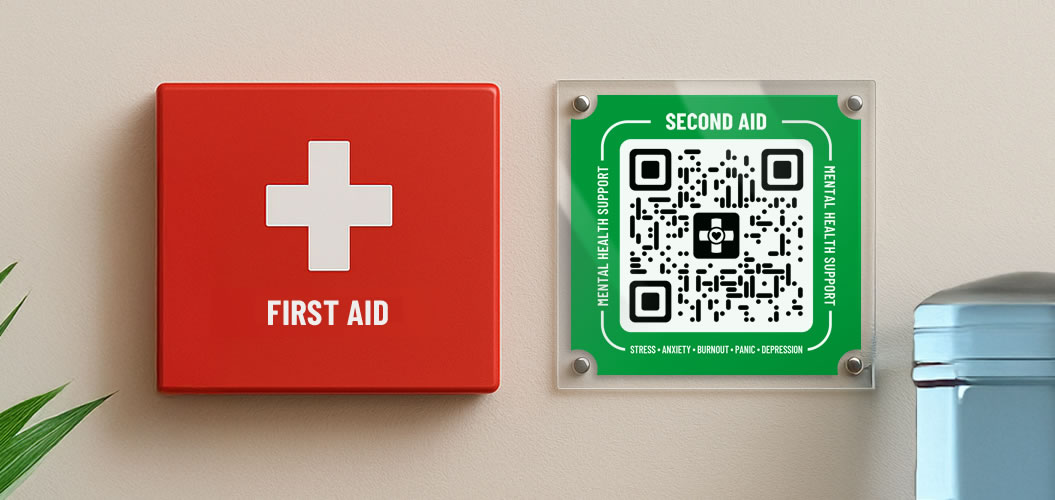
What First Aid is to Physical Health, Second Aid is to Mental Health. First Aid enables people to stabilise physical injuries before professional medical treatment is available. Second Aid applies the same principle to mental health, providing immediate tools that individuals can use to help stabilise emotional distress.
The system is delivered through Second Aid kits: simple QR codes that provide access to guided, interactive psychological exercises. These exercises are designed to support people experiencing panic, anxiety, overwhelm, stress, grief, low mood and other forms of emotional distress. Because each kit is simply a printed QR code, it can be deployed immediately and at minimal cost, alongside existing First Aid kits.
Unlike counselling or therapy, Second Aid is designed for immediate self-use. It does not require an appointment, account, diagnosis, personal information or professional training. Second Aid can be accessed directly at secondaid.com or through licensed QR kits installed in workplaces, educational institutions, healthcare settings and public spaces.
Like First Aid, its defining purpose is not to replace professional healthcare, but to provide an accessible, self-use first response before further care is required or available, helping reduce escalation to crisis and, in turn, preventing healthcare systems from being overwhelmed.
Without First Aid, physical healthcare systems would be overwhelmed, resulting in avoidable fatalities. This is the current state of mental health: without Second Aid, mental healthcare systems will remain overwhelmed with continued avoidable high fatality rates.
First Aid vs Second Aid
The relationship between First Aid and Second Aid is based on their functional roles within healthcare.
| First Aid: Physical Health | Second Aid: Mental Health |
|---|---|
| Provides immediate support for physical injury. | Provides immediate support for emotional distress. |
| Helps stabilise the body. | Helps stabilise the mind. |
| Helps prevent infection and complications. | Helps prevent escalation and rumination. |
| Can be used without a medical professional. | Can be used without a mental-health professional. |
| Buys time for professional treatment, where needed. | Buys time for professional support, where needed. |
The comparison concerns the role of early stabilisation, not an equivalence between physical injuries and psychological conditions. Neither First Aid nor Second Aid replaces professional healthcare. Both are intended to provide practical support at an earlier stage.
Where It Fits
Second Aid is intended to operate alongside existing mental-health support systems. A person experiencing emotional distress may require different levels of support depending on the severity, duration and nature of their circumstances.
-
Immediate Stabilisation
Second Aid provides interactive exercises that can be accessed immediately and used privately. For some episodes of temporary distress, these exercises may provide sufficient support for the person to regain composure and continue with their activities.
-
Human & Professional Support
If additional assistance is needed, the person, now with a calmer mind, is better placed to contact somebody they trust; a trained supporter, counsellor, therapist, Employee Assistance Programme (EAP), occupational-health service or other qualified professional. Second Aid is complementary to these services.
-
Crisis & Emergency Intervention
Where there is an immediate threat to life or safety, emergency or crisis services are required. Second Aid has emergency numbers built in, so this level can be reached in one tap from within the app. Its exercises are not a substitute for emergency assessment or intervention.
These levels are not mandatory sequential steps. Someone facing immediate danger should call emergency services first (one-click calls accessible within Second Aid).
What It Is Not
Just as First Aid does not replace a doctor, Second Aid does not replace psychotherapy, clinical treatment, medical diagnosis or professional mental-health care. It does not diagnose mental-health disorders, prescribe treatment, monitor individual medical conditions or determine whether somebody requires emergency intervention, but provides one-tap access to emergency services.
Second Aid is also distinct from, though informed by, two established approaches:
- Mental Health First Aid (MHFA)
-
MHFA programmes train people to recognise the signs of mental-health difficulties and provide initial assistance to others. Second Aid draws on its core principles, applied directly by the person in distress, but does not reproduce every function of MHFA.
- Psychological First Aid (PFA)
-
PFA is a framework for providing humane, practical and supportive assistance, traditionally following disasters and emergencies. Second Aid draws on its core principles, applied in everyday environments, but does not reproduce every function of PFA.
The key difference is in delivery: training prepares people to support others, while Second Aid gives the person in distress direct access to support.
| Training (MHFA, PFA) | Second Aid |
|---|---|
| Requires time and instruction. | Immediate access. |
| Depends on trained individuals. | Self-use. |
| Limited availability in real time. | Available at the point of need. |
| Support delivered through another person. | Support accessed directly. |
Second Aid kits complement both, just as First Aid kits complement staff trained in First Aid: providing critical support when a trained person is unavailable or not approached.
Design Principles
Second Aid's design draws on principles from epidemiology, social science and behavioural psychology, so that immediate support is not only available but used.
- Scalable self-administration
- Training-based support is limited by the number of trained people available. Because Second Aid is self-administered, it can scale across populations without a proportional increase in trained personnel.
- Bypassing stigma
- Non-engagement is a major barrier to mental-health support. Private, anonymous use, with no need to admit distress or give an identity, reduces stigma and increases real-world use.
- Environmental cues
- Access alone does not ensure use. Placing Second Aid alongside First Aid kits provides a visible cue at the moment distress occurs, closing the gap between availability and action.
- Stabilisation first
- A dysregulated mind cannot absorb instruction. For acute distress, Second Aid regulates the body first, through paced breathing, before introducing reflection.
Together, these principles allow established psychological methods to be delivered at the scale, and at the moment, that immediate support requires.
Highlights
Second Aid is already in use worldwide, supported by real-world evidence and, since April 2026, part of employers' health-and-safety obligations.
-
The Missing Public-Health Infrastructure
Mental healthcare lacks the First Aid layer that physical healthcare relies on. Without immediate support, emotional distress can escalate while people wait for, or avoid, professional help. Second Aid is designed to close that gap: self-administered, private and placed at the point of need, with the potential to reduce escalation and pressure on mental-health services at population scale.
-
Immediate, 100% Private, 10+ Languages
One scan of a Second Aid QR code gives immediate access to guided self-stabilisation, with no account, download or personal information required. One-tap options to talk to someone or contact emergency services are built in, in 10+ languages across 140+ countries, on infrastructure built to serve over one million new users per minute.
-
A Legal Obligation Since April 2026
Health-and-safety law requires employers to address foreseeable risks where a feasible control exists. Since April 2026, Second Aid has provided that control for three previously uncontrolled workplace mental-health support gaps, so employers are now legally obliged to address them.